Ion Source Technical Description
The ion source (Figure 4-1) in the isoprime precisION IRMS use electron impact on gas molecules to generate molecular ions within a block held at an accelerating voltage relative to focusing and steering lenses situated beyond an exit slit in the source.
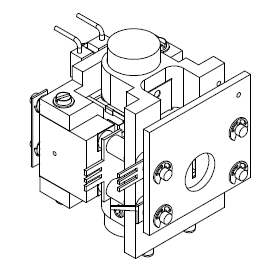
Within the enclosed ion chamber is an ion repeller that works in tandem with the extraction lens to remove ions from the block through the ion exit slit.
Focusing of the resulting ion beam onto the optical defining slit is achieved by the extraction lens which consists of two plates to which are applied firstly a proportion of the accelerating voltage (to reduce the width of the beam at the defining slit) and secondly, a differential voltage steers the ion beam towards the defining slit. The defining slit is at ground potential, which, in conjunction with the accelerating voltage applied to the ion chamber, serves to accelerate ions from the ion exit slit to the defining slit whence they enter the field free region before entering the magnetic sector.
Immediately beyond the defining slit are a pair of Z deflection plates to steer the beam into the flight tube between the main magnet poles so that it enters the collectors correctly.
The impacting electrons are accelerated into the ion chamber from a thoria coated filament through a tiny hole at the top of the source by applying a differential voltage to the filament. Unhindered electrons pass across the ion chamber through a larger hole at the bottom of the chamber to strike the “trap plate”. This trap current is regulated by negative feedback on the filament current supply. The thoria coating on the filament acts as a moderator to reduce the energy spread of the electrons as they leave the filament so that impacting collisions in the ion block are of similar energy, thereby reducing the energy spread of the ions leaving the source, and resulting dispersion in the magnet sector.
The electron passage through the source is assisted by the field from a pair of magnets above and below the source. These result in a spiral trajectory, allowing a greater volume to be swept out by the electrons as they travel to the trap plate, and a consequent increase in collision probability.